
Larger NGOs could no longer work with smaller ones, especially those organisations working on the ground that had no means of or expertise in raising money themselves, reveals Aakar Patel.

US Secretary of State Marco Rubio arrived in Kolkata for a four-day diplomatic tour to India, marking the first visit by a US secretary of state to the city in 14 years. His itinerary includes meetings with Indian officials, energy talks, and a Quad Foreign Ministers Meeting.

Congress leader Rahul Gandhi has called on Prime Minister Narendra Modi to address the escalating conflict between the US, Israel, and Iran, particularly regarding the alleged assassination of the Iranian Supreme Leader. Gandhi emphasised the need for India to uphold international law and advocate for peaceful resolution.

Market participants are keenly awaiting regular, preferably weekly, updates from the Reserve Bank of India (RBI) on Foreign Currency Non-Resident (Bank), or FCNR (B), deposits, following the central bank's directive for banks to submit daily data on these inflows.

'People don't like leaders who just crib and complain without offering a clear objective.' 'Theoretically and pragmatically, Rahul has to show an agenda beyond bad-mouthing Mr Modi on economic policies, foreign policy...'


State Bank of India Chairman C S Setty has expressed support for a 'pause' in policy rates by the Reserve Bank of India's monetary policy committee, believing it will help stabilise conditions and support economic growth. He also urged investors to look beyond short-term equity market movements and focus on India's structural transformation, driven by reforms and digital infrastructure.
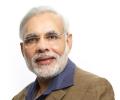
The major driver of Mod's foreign policy can be gauged from his economic priorities such as creating employment opportunities for the youth bulge. Related to this is emphasis on manufacturing, and infrastructure development, which in turn raises the issue of FDI. He has already articulated his views on all these issues, says Rup Narayan Das.

P V Narasimha Rao strongly felt that the reforms would have to be mindful of Indian concerns and would have to protect the interests of our poor and our working people, he said.

India's foreign exchange reserves saw a substantial increase of USD 9.063 billion, reaching USD 697.121 billion for the week ended April 3, 2026, according to the Reserve Bank of India (RBI). This surge follows a previous week's decline and brings the reserves closer to their all-time high.

'After more than 12 years in power, he has been forced to retreat under public pressure. The education minister's resignation is the biggest political climbdown of his government so far.'

'Banking is the only sector that can see double-digit growth in FY27.'

Indian benchmark indices Sensex and Nifty closed marginally lower due to profit-taking, following the Reserve Bank of India's decision to keep the repo rate unchanged while lowering its growth expectations for the current fiscal year and forecasting higher inflation.

It, however, conceded that 20 per cent blending of ethanol with petrol leads to 3-5 per cent lower mileage in vehicles than conventional petrol, but said the blend offers a significantly higher octane rating, superior anti-knock properties, faster combustion, better pickup, smoother acceleration, and cleaner engine operation.

Iran was the chance to arrange a concert of nations, to actually be a Vishwaguru. Instead, we are watching from the sidelines as Pakistan, the same country that is apparently still at war with Afghanistan, hosts talks between US-Israel and Iran. The irony is hard to miss, points out Amberish K Diwanji.

The United States Trade Representative (USTR) has expressed concerns that India's Digital Personal Data Protection (DPDP) Act, particularly the lack of a deemed consent mechanism for credit information companies, and the Information Technology (IT) Rules of 2021, along with frequent internet shutdowns, could negatively impact the ability of US companies to operate and trade in India.

US Secretary of State Marco Rubio will visit India for four days to strengthen bilateral relations, holding talks with Indian leaders and attending the Quad foreign ministers' meeting.

Indian benchmark equity indices, Sensex and Nifty, extended their winning streak for a third consecutive day, driven by a rally in IT stocks and global cues suggesting a more accommodative monetary policy after softer-than-expected US jobs data.

BCCI secretary Devajit Saikia stated that India's roadmap for the 2027 World Cup, including discussions on senior players like Rohit Sharma and Virat Kohli, is confidential and not for public consumption. He also clarified that the BCCI adheres strictly to the Government of India's policies regarding bilateral tours, such as the potential resumption of ties with Bangladesh, without concern for the political situation in other countries.
The BJP today said if voted to power, it would pursue a "muscular and far-sighted foreign policy" to secure India's interests, which the party alleged had been "substantially compromised" by the United Progressive Alliance government.
The Pakistani military has ousted the civilian government from the role making strategic decisions and has taken virtual control of the foreign policy, a noted and award-winning Pakistani journalist said on Tuesday. "Pakistan's military has virtually taken control of foreign policy and strategic decision making from the civilian government.Thus Pakistan's foreign policy reflects the military's obsession with India," wrote Ahmed Rashid in The Washington Post.

Dharmendra Pradhan's resignation is significant because it punctures, however slightly, the perception that the Modi government never retreats under pressure. Every long-serving government eventually reaches a point where every institutional failure is identified with the leader himself. Removing the minister may have prevented that political burden from falling directly on Modi. Whether it also resolves the underlying crisis is another matter, notes Ramesh Menon.

'When we start describing somebody as an enemy that is the start of politics and emotion after which no business can take place.' 'We need to get out of this, allow Indian businessmen to do business with China.'
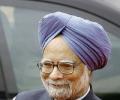
We present the highlights of Prime Minister Manmohan Singh's address at the annual conclave of Indian ambassadors/high commissioners abroad in New Delhi on Monday.

The Indian stock market's trajectory this week will be significantly influenced by crude oil prices, global market trends, and the commencement of the corporate earnings season, with IT major TCS set to announce its June-quarter results on July 9.

The Directorate of Revenue Intelligence has conducted a nationwide crackdown on wildlife trafficking, seizing over 440 endangered animals and 15 kg of ivory, and arresting 33 individuals involved in organised crime syndicates.

Foreign Portfolio Investors (FPIs) have withdrawn over Rs 62,853 crore from Indian equities in the first fortnight of June, bringing the total outflows for 2026 to Rs 2.87 lakh crore, surpassing the entire 2025 figure, driven by geopolitical tensions, global economic growth concerns, and a weakening rupee.

'The big power struggle in faraway Europe erupted at a most critical juncture when India has been increasingly sceptical about American policies and statesmanship,' argues Ambassador M K Bhadrakumar.

Bangladesh summoned India's Deputy High Commissioner to convey "deep disappointment" after Dr. Zahed Ur Rahman, an adviser to the Prime Minister, was stopped and questioned by immigration authorities at Delhi's Indira Gandhi International Airport. The incident led to Rahman's decision to return home despite being cleared to proceed.

'In all these years of rupee depreciation, of rising oil prices, of inflation caused by import dependence, not one leader had the courage to look the people in the eye and say: Please do this for your country.'

'If the war continue for a longer period of time, it is just a matter of time before the government will pass on some of the price increases.'
The statement by United States president-elect Barack Obama regarding American intervention in Kashmir is his first foreign policy mistake, a leading expert on South Asia said on Tuesday. A Kashmir initiative by America, however veiled, can undermine improving India-US ties, Selig S Harrison, director of Asia Programme at the Center for International Policy and a senior scholar of the Woodrow Wilson International, said an opinion piece published in The Washington Times.

The Indian equity market is set for an event-heavy week, with analysts pointing to the Reserve Bank of India's (RBI) interest rate decision, developments in the US-Iran situation, and crude oil prices as the primary determinants of market trends.
Slamming government's foreign policy as "hazy and directionless", the BJP on Tuesday said India cannot become a super power by "riding piggy back" on the US and wondered why efforts were not being made to counter China's attempts to attain dominance in South Asia.

The US foreign policy under President Donald Trump would put "America first" and would be based on the principle of "peace through strength," the White House said today, hinting at massive military expansion under the new administration to maintain "unquestioned" US military dominance.

The Congress on Sunday lashed out at Prime Minister Narendra Modi over the US' statements after three Indian sailors were killed in American attacks on ships, with party leader Rahul Gandhi saying the "compromised PM" listens "like an obedient servant" and "complies with the orders".

India observed the first anniversary of the Pahalgam terror attack, with leaders paying homage to the victims and asserting the country's commitment to fighting terrorism.

Sharad Pawar objected to comparing PM Modi with Jawaharlal Nehru, highlighting Nehru's sacrifices and nation-building contributions.
Why would a country that requires close to $90 billion in net foreign capital annually to create jobs, build productive capacity, and sustain rapid growth permit $30 billion of capital to flow abroad, thereby contributing to pressure on the rupee? asks Debashis Basu.

A public exchange of open letters between Congress leaders Mani Shankar Aiyar and Shashi Tharoor reveals a significant rift over foreign policy, particularly concerning Israel and the Sabarimala temple issue.
